
In most U.S. states, a custody agreement and a parenting plan describe the same thing: a written document that says where your child lives, how decisions get made and how the two of you handle disagreements. The label changes by state and by court. What matters is whether the document is detailed, fits your state's rules and becomes a court order. A parent can draft that document alone, then bring it to the other parent, a mediator or a judge. That is the job our platform was built for.
TL;DR
- “Custody agreement” and “parenting plan” are often two names for one document. The Maryland People's Law Library says outright that a parenting plan can also be called a custody agreement.
- A parenting plan usually covers two things: a parenting schedule (physical custody) and decision-making authority (legal custody).
- An agreement you sign privately is only a starting point. It becomes enforceable when a judge signs it and it is filed as a court order.
- Rules differ by state: some courts require a parenting plan in every case, and some avoid the word “custody” altogether.
- One parent can draft a complete, state-specific plan first, which keeps the negotiation anchored to your draft instead of a blank page.
Table of Contents
- Why the two terms get confused
- Custody agreement vs. parenting plan: where the difference actually lives
- What a strong plan contains
- How the schedule fits real life
- What changes by state
- Making it binding
- Why drafting first helps
- Our perspective
- Build your plan with CoParent Navigator
- FAQ
- Sources
Why the two terms get confused
The confusion is real because the law itself is inconsistent. Courts, forms and statutes each use their own vocabulary.
The San Diego County Superior Court's family court handbook defines a parenting plan, also called a “custody and visitation agreement,” as the parents' written agreement about time-share and decision-making concerning the children's health, education and welfare. The Alaska Court System likewise says a parenting plan is also called a custody and visitation plan.
Washington goes further. Its courts use “residential schedule” and “decision-making authority” instead of “custody” and “visitation,” according to Washington Law Help. The American Bar Association's 2025 custody statutes chart notes that state terminology varies and follows each state's statute text.
So if you search for two documents, you may be searching for one. The practical question is not which label to use. It is whether your document contains the right terms and whether a court has approved it.
Custody agreement vs. parenting plan: where the difference actually lives
When people do draw a line, it usually falls in one of three places.
Scope: custody labels vs. a full operating manual
A “custody agreement” in everyday speech often means the headline arrangement: sole or joint, who the child lives with. A parenting plan is understood as the fuller document that works out the daily mechanics.
The San Diego handbook explains the headline terms. Physical custody means where children live and how they spend their time, and it can be sole or primary (children live with one parent most of the time) or joint (children live with both). Legal custody, per the California Courts self-help guide, is who makes important decisions such as education and health care.
Those labels are the skeleton. The plan adds the schedule, the exchanges, the holidays and the rules for settling disputes.
Status: a private deal vs. a court order
This is the difference that matters most. A document the two of you sign at the kitchen table is an agreement between you. A parenting plan that a judge has approved is an order.
In California, for example, parents sign form FL-355, with FL-341 or their own attached paper for the details. Then they take it to a judge for signature. The state's self-help guide says there is generally a $20 filing fee, and that once the agreement is signed and filed it becomes a court order both parents must follow.
Maryland works similarly: the plan goes to the court, where a judge reviews it against best-interest factors and incorporates it into an enforceable order. Cornell Law School's Legal Information Institute summarizes the general rule: a parenting plan generally must be agreed to by the parents and approved by the court, and if they cannot agree, or the court rejects their proposal, the court may set the plan itself.
Requirement: optional paperwork vs. mandatory filing
In some states you may choose whether to write a plan. In others the court demands one. New Hampshire requires parents in proceedings to establish or modify parenting time to develop and file a parenting plan, with limited exceptions, under RSA 461-A:4. Georgia has required parenting plans in custody and visitation cases filed after January 1, 2008, according to GeorgiaLegalAid. Pennsylvania requires plans in contested custody proceedings under 23 Pa. Cons. Stat. § 5331.
| | Informal custody agreement | Court-approved parenting plan | |---|---|---| | Who signs | Both parents | Both parents, then a judge | | Legal force | A private understanding | A court order | | Detail | Often a few lines on who lives where | Schedule, decisions, exchanges, disputes | | If someone breaks it | You have little to enforce | The court can act | | Best used | As a draft to build from | As the final document |
What a strong plan contains
Whatever you call it, courts and self-help centers describe much the same contents. Georgia's statute, as summarized by Cornell LII, lists these:
- where and when the child is in each parent's physical care
- holiday, birthday, vacation and school-break arrangements with start and end times
- transportation and exchanges, including who pays
- any needed supervision
- decision-making authority over education, health, extracurriculars and religious upbringing, with a way to resolve disagreements
- limits on the other parent's contact or access to information
The Alaska court puts it in two parts: a parenting schedule with specific days, times, transport and transfer locations, and a decision-making section on how health, education and social decisions are made. Maryland's instructions add dispute resolution, child care, and out-of-state travel.
The San Diego handbook gives a useful test for quality: a good plan meets the children's basic needs, fits their ages and personalities, sets regular and consistent times, and is detailed enough to be easy to understand and enforce.
Detail is what makes a plan enforceable
Vague language is where plans fail. “Reasonable visitation” cannot be enforced because nobody can say when it was violated. Pennsylvania's law says the court must specify custody terms in enough detail to allow enforcement through law enforcement authorities. A plan that names the day, the hour, the exchange location and who drives gives everyone a clear standard.
Here is a worked example of the difference.
- Vague: “Dad has the kids on alternating weekends and some holidays.”
- Specific: “Dad has the children every other weekend from Friday at school dismissal until Sunday at 6 p.m. Exchanges happen at the children's school or, when school is out, at Mom's residence. The parent receiving the children provides transportation. Thanksgiving alternates yearly, starting with Dad in odd-numbered years.”
The second version leaves little to argue about. Our library of research-backed clauses is organized around exactly this kind of specificity. For concrete wording, see our parenting plan examples.
How the schedule fits real life
A schedule has to work around jobs, school start times and distance, not just around what looks fair on paper. If one parent works rotating shifts or relies on gig income, the weekly rhythm needs room for that. Some parents look at flexible ways to earn around your kids when they are rebuilding their working hours around a new parenting-time arrangement.
Percent labels such as 70/30 describe how overnights divide across a year, not a specific calendar. Several different weekly patterns can produce the same split. Our guides on choosing a parenting time schedule and building a co-parenting schedule by age walk through the common patterns.
What changes by state
Because custody is governed by state law, the same plan can be right in one state and incomplete in another. Three examples show the range.
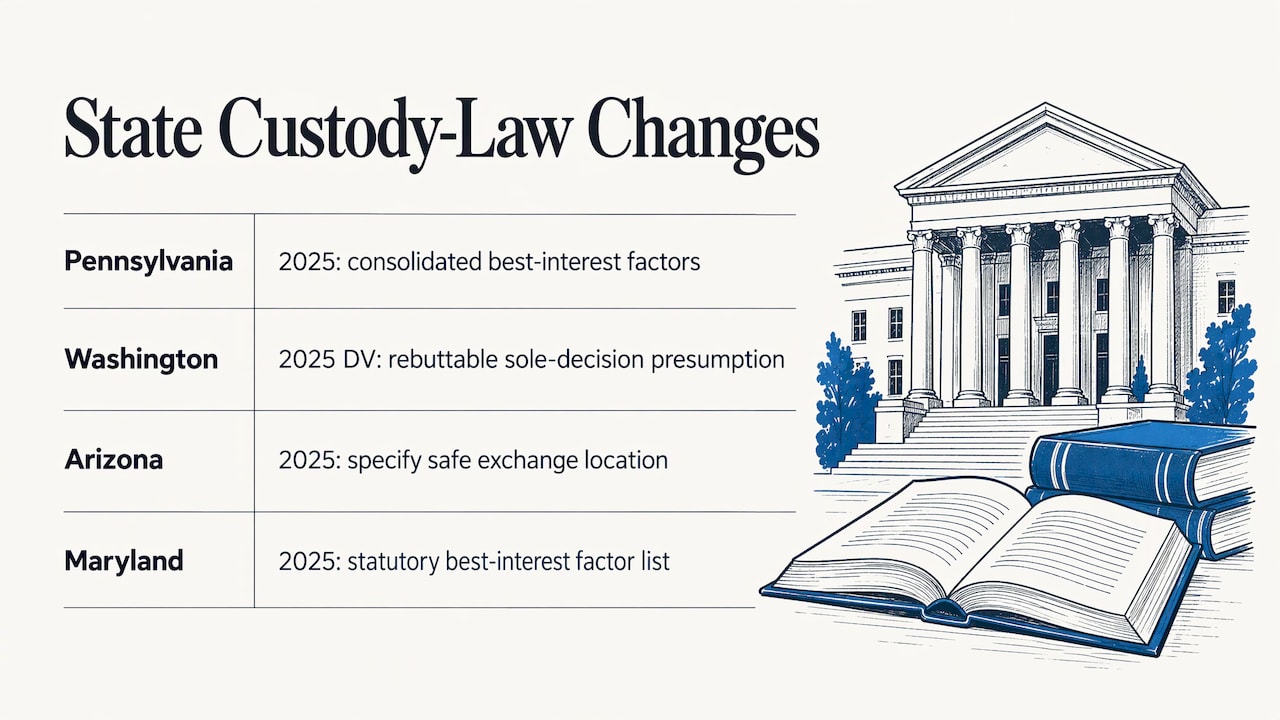
Pennsylvania. Courts weigh all relevant best-interest factors, with substantial weighted consideration given to safety factors such as which parent is more likely to ensure safety and any history of abuse. The statute was amended in 2025, per the ABA chart, to consolidate its best-interest factors. Contested cases require a plan with a schedule, education and religious involvement, health care, child care, transportation and a procedure for resolving disputes.
Washington. The court-ordered document is called a Parenting Plan. It covers where the children live most of the time, how much time each parent gets, who makes major decisions, how disputes are worked out, and restrictions where there are serious safety concerns. Temporary plans govern while a case is pending and are easier to change; the final plan is meant to be permanent. A 2025 Washington law, noted by the ABA, created a rebuttable presumption of sole decision-making after a domestic violence finding.
Arizona and Maryland. Per the ABA, Arizona's 2025 legislation added that parenting plans must specify when an exchange takes place at a safe exchange location, and Maryland's 2025 legislation added a statutory list of best-interest factors for legal and physical custody.
Two lessons follow. First, rules move: statutes get amended, and a template from a few years ago may miss a requirement. Second, the best-interest standard is what a judge ultimately applies. Utah's code, for instance, directs courts to consider the child's best interests in any custody and parent-time decision and to decide by a preponderance of the evidence (Utah Code 81-9-204). A plan that centers the child's routine and safety is the plan most likely to be approved.
We write our state-specific plans against current requirements and update the legal guidelines regularly. For one state's walk-through, see our California parenting plan guide.
Making it binding
The steps vary by court, but the pattern is consistent.
- Draft the plan. Cover the schedule, decisions, exchanges, holidays, communication and dispute resolution. This is the step where a state-specific structure saves the most time.
- Agree, or narrow the disagreement. If you agree, you can usually submit a joint plan. In Georgia, parents who cannot agree each submit a separate plan, and the court can decide only the disputed issues.
- Use the court's forms. Many courts supply their own. California's FL-355 is a signed cover sheet for the agreement.
- Get the judge's signature and file. The plan is not binding as an order until then. Our guides on how to file a parenting plan with the court and what to include for court cover this stage.
- Follow it, and document how it goes. Orders can be enforced. In New Hampshire, a parent facing substantial, unjustified interference with parenting time can file a family access motion, and remedies can include compensatory time of at least the period denied, a fine of up to $500 and attorney's fees. In Pennsylvania, willful noncompliance with a custody order can lead to a contempt finding.
The filing step is a court function, so it stays with the court. Everything before it, the drafting, is where preparation pays off. If you are not sure about filing rules in your county, the clerk's office or a family law attorney can answer for your court.
Why drafting first helps
Traditional co-parenting negotiation often starts with a blank page and an argument about who proposes what. That produces delays, extra attorney hours and misunderstandings. Our approach lets one parent draft a complete plan independently, which cuts friction and the fees that come with back-and-forth.
A finished draft changes the conversation. The other parent, a mediator or an attorney can respond to specific clauses instead of arguing in generalities. If you are heading into mediation, a plan evaluation and preparation tools help you walk in knowing which terms matter most to you.
This is also useful for professionals. Mediators and family law attorneys can use structured resources to keep client communication in one place; see our page for attorneys.
Our perspective
Parents ask us whether they need a custody agreement or a parenting plan. Our answer is that they need one good document, and the word on the cover matters far less than what is inside it.
The documents that cause trouble are the short ones. A plan that says “reasonable” anywhere a time, place or person should be named invites the next argument. We built our library of research-backed clauses so that a parent does not have to invent that language from scratch or guess what their state expects.
We also believe one parent should be able to start. Waiting for a hostile co-parent to cooperate on a blank page costs weeks and money. A complete, state-specific draft gives everyone something concrete to react to, and it keeps the conversation on the child's schedule instead of on old grievances.
Finally, the plan lives beyond signing day. That is why we pair the drafting tools with a secure workspace for communication and documentation, so the record of how the plan is working stays in one place.
Heather
Build your plan with CoParent Navigator
CoParent Navigator is a web-based platform for creating a personalized, state-specific parenting plan from a library of research-backed clauses. It includes parenting plan evaluation, mediation preparation tools and a secure workspace for co-parent communication and documentation. One parent can draft independently, then take the result to the other parent, a mediator or the court.

Start with the custodial plan builder, see plans and pricing, or try the free co-parenting tools for schedules.
FAQ
Is a parenting plan the same as a custody agreement?
Usually, yes. Several state sources, including the Maryland People's Law Library and the San Diego court handbook, say a parenting plan can also be called a custody agreement or a custody and visitation agreement. Some states avoid the word custody and use terms like residential schedule and decision-making authority.
What is a parenting plan, in simple terms?
It is a written document describing how two parents who live apart will care for and make decisions about their child. It typically covers the parenting schedule, holidays, exchanges, who decides on health and education, and how disagreements get resolved.
Does a parenting plan have to be approved by a court?
To be enforceable as an order, yes. A judge generally reviews the plan against the child's best interests and signs it, after which it is filed as a court order. Some states, such as New Hampshire and Georgia, require a plan in custody proceedings.
Can one parent write the plan alone?
Yes. One parent can prepare a full draft and propose it. If the other parent agrees, you submit it jointly. If not, the draft becomes your position in mediation or court, where a judge decides disputed issues based on the child's best interests.
Sources
- Parenting Plan, The Maryland People's Law Library
- Parenting plan, Wex, Cornell Legal Information Institute
- Parenting plan guide, Washington Law Help
- Developing a Child Custody Parenting Plan, San Diego Superior Court
- Prepare a custody and visitation agreement, California Courts Self-Help
- Parenting Plans, Alaska Court System Self-Help
- Chapter 461-A Parental Rights and Responsibilities, New Hampshire
- Title 23 Domestic Relations, Chapter 53, Pennsylvania
- Custody and Parent-time Between Parents, Utah Code
- Child Custody Statutes in 2025, American Bar Association
- Child custody, GeorgiaLegalAid.org
- Work From Home for Parents
Recommended
- Legal Custody vs Physical Custody Explained
- Writing a Parenting Plan: Step-by-Step Guide and Checklist
- Joint Custody Plan: A Practical Guide for Families
- Parenting Plan for Court: What to Include and How to File
Informational only, not legal advice. Review filing, approval and enforceability requirements with a qualified professional in your jurisdiction.
Start building your parenting plan today
Build a complete parenting plan with CoParent Navigator, the child-centered way to a custody agreement that holds up.